

Discovering EURECA-PRO's Flagships:
Sustainable Materials for Buildings
The buildings and construction sector is responsible for a major share of global greenhouse gas emissions. Addressing this challenge requires new approaches to the materials used to build our homes, workplaces and infrastructure.
The Sustainable Materials for Buildings (SuMaB) Flagship brings together expertise from material science, engineering, architecture, biology, environmental science, economics, supply chain management and industrial design to promote more sustainable and resource-efficient building materials.
What is the aim of your Flagship initiative, and what areas of expertise does it bring together within the EURECA-PRO Alliance?
The buildings and construction sector is by far the largest emitter of greenhouse gases, accounting for a staggering 37% of global emissions. The production and use of materials such as cement, steel and aluminium have a significant carbon footprint.
The Sustainable Materials for Buildings (SuMaB) Flagship is an interdisciplinary European academic community aiming to promote environmentally safe, resource-efficient building materials that reduce waste and support circular economy principles. SuMaB addresses several thematic areas, including natural materials, such as bio-based, earth-based and renewable materials for sustainable construction; recycled materials, including secondary raw materials, construction and demolition waste and industrial by-products; and innovative composites and hybrids, combining different materials to enhance performance while reducing environmental impact.
The Flagship also focuses on innovative construction techniques, including Building Information Modelling (BIM), automation, robotic tools, Structural Health Monitoring (SHM) and prefabrication.
SuMaB therefore brings together expertise in material science, engineering disciplines and architecture, microbiology and biology, environmental science, economics, supply chain management and industrial design.
What research questions or societal challenges do you hope to help address through this European academic community?
Through its activities, the SuMaB Flagship aims to address major societal challenges including climate change, resource depletion, energy poverty and public health risks.
Plant-based and recycled materials have a substantially lower carbon footprint, while smart sustainable alternatives can capture carbon. Reused, recycled and rapidly renewable materials help save natural resources and reduce construction and demolition waste.
Sustainable insulation materials can enhance thermal comfort and reduce energy bills, while non-toxic, natural materials can contribute to healthier homes and workspaces.
In your view, what makes a EURECA-PRO Flagship initiative strong, and what do you hope to achieve collectively in the coming years?
EURECA-PRO Flagship initiatives emerge and grow within the European University Alliance. Their role goes far beyond generating tangible knowledge: they aim to build meaningful relationships and interconnected research environments – “bridged labs” that facilitate long-term collaboration and help transform EURECA-PRO from a network of institutions into a truly integrated European University.
The SuMaB Flagship is a community of researchers, academics and industry partners with long-standing expertise in sustainable construction materials. Through attractive educational offers, networking and outreach activities, we aim to grow the community, draw in new members and make the Flagship a self-reinforcing hub where education, research and collaboration feed into each other to advance responsible consumption and production.
The long-term vision of the Flagship is to establish an EURECA-PRO Faculty on Sustainable Materials for Buildings.
Contacts:
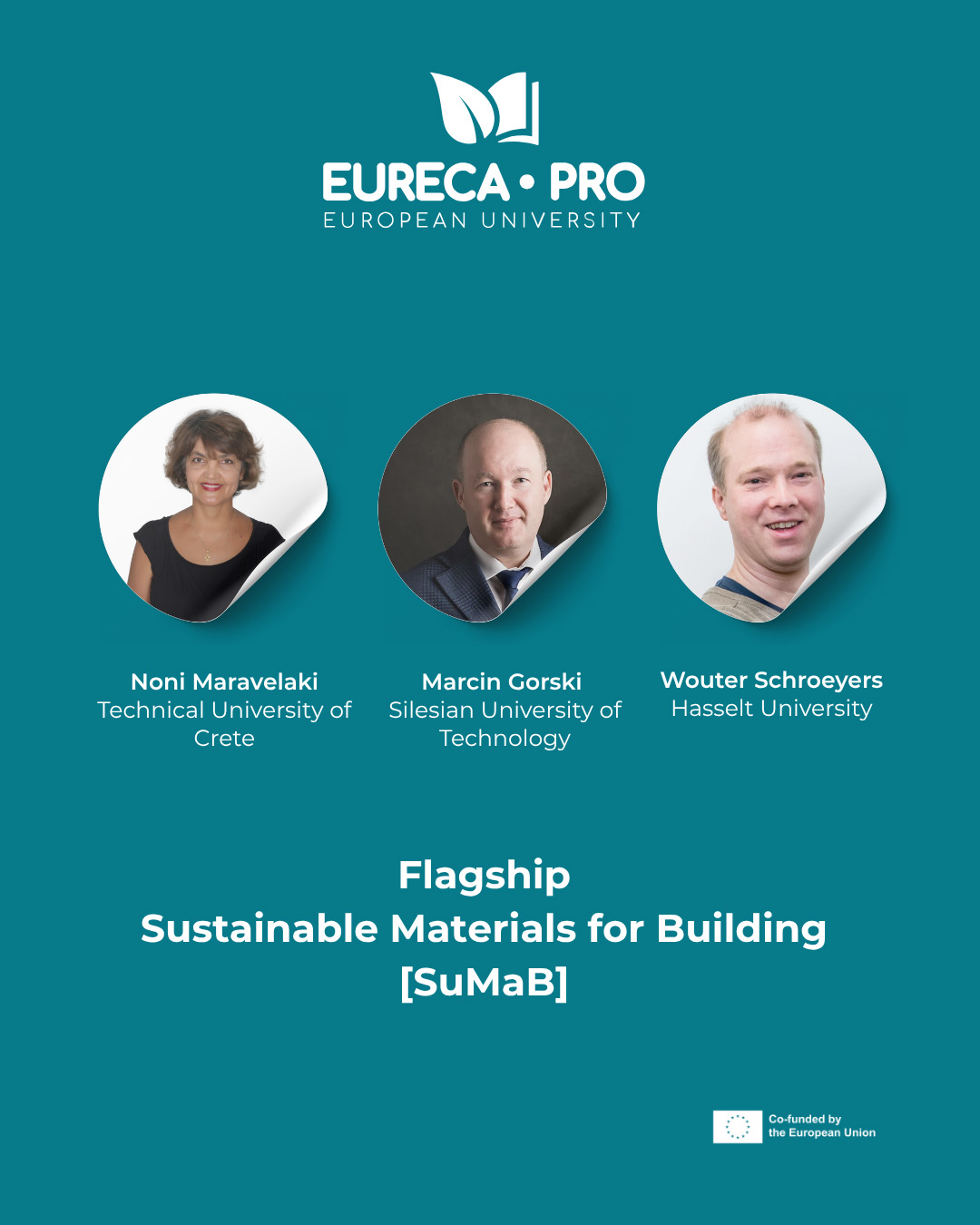
Noni Maravelaki (Technical University of Crete): pmaravelaki(at)tuc.gr
Marcin Gorski (Silesian University of Technology): marcin.gorski(at)polsl.pl
Wouter Schroeyers (Hasselt University): wouter.schroeyers(at)uhasselt.be
