

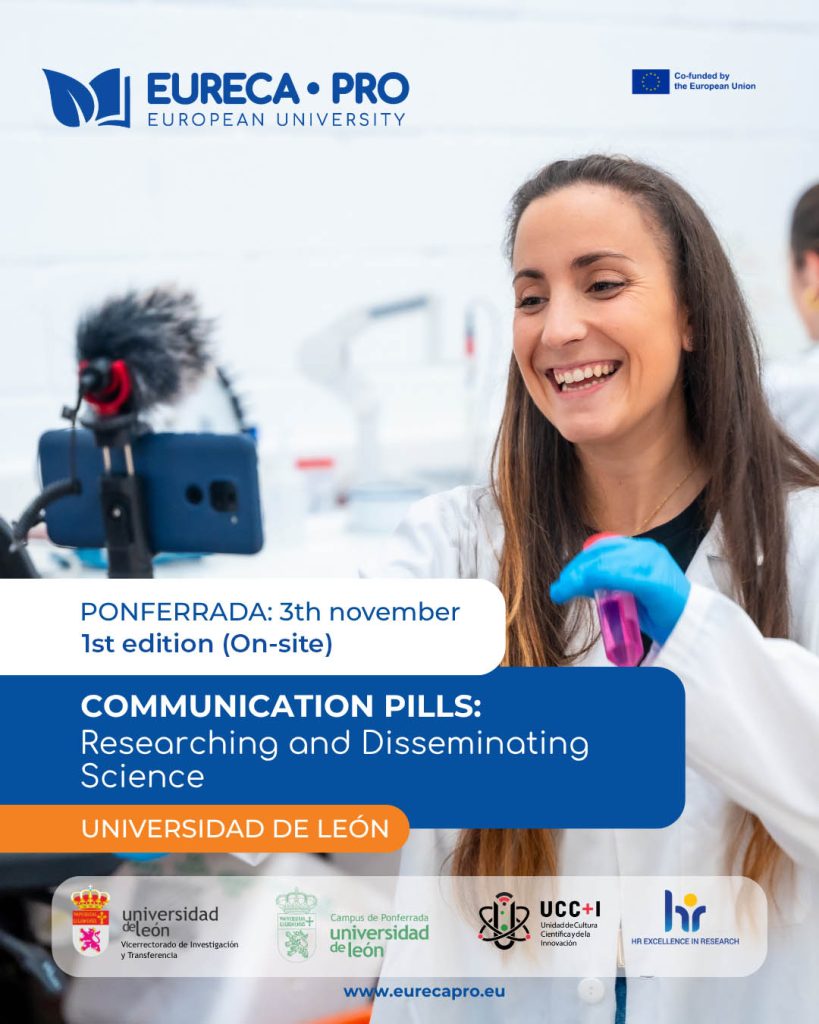
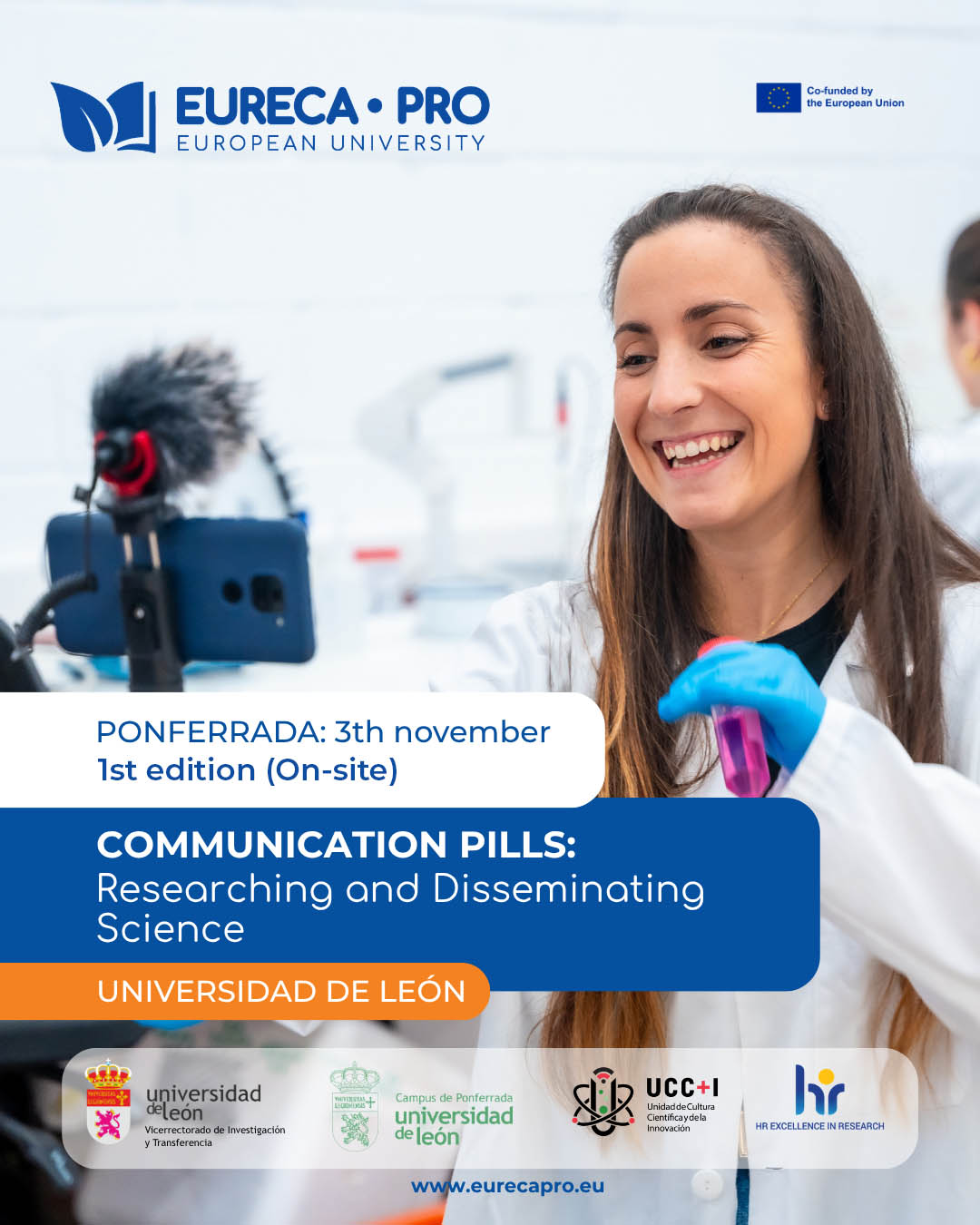
Communication Pills: Researching and disseminating science
(Ponferrada edition)
EURECA-PRO Lifelong Learning Academy - Online Course
University involved: University of León
- Upcoming events
Course Type:
Physical / online tutorial
Number of places:
16 places
Starting date:
3/11/2026
Ending date:
9/11/2026
“Communication Pills: Research and Dissemination” is a practical course aimed mainly at teaching and research staff at the University of León who want to communicate and disseminate their research through audiovisual formats. No previous experience in video production is required.
The main objective is to teach participants how to transform complex scientific research into clear, engaging, and accessible audiovisual content, increasing the visibility and impact of their work.
Key details
Mobility: Physical
Language: Spanish
Audience: Research and Teaching Staff
Recognition of credits: 1 ECTS
University involved: University of León
3 November — 11:00 a.m. to 2:00 p.m. | In-person class — Room 608-C, Ponferrada Campus
3–9 November: Practical exercise (independent work, 4 hours)
9 November — 11:00 a.m. to 1:00 p.m. | Online tutorial (2 hours)
Assessment criteria: Mandatory attendance of 80% and successful completion of the practical exercise.
Objectives
The overall aim of the course is to train research staff and PhD students to plan, record and edit high-quality audiovisual content that amplifies the visibility and impact of their scientific work. Through a dynamic, hands-on approach, participants will be equipped with practical resources to distil complex concepts into formats that are engaging and accessible to both the academic community and society at large.
The course’s specific objectives are to:
- Synthesise and structure the message: design dynamic scripts to turn complex research into clear, engaging audiovisual narratives.
- Make the most of participants’ own resources: master basic framing, lighting and sound-capture techniques using accessible tools (smartphone, webcam or a basic microphone).
- Record presentations and screen content: use screen-capture software to seamlessly integrate graphics, slides and the researcher’s voice-over.
- Edit and polish content: use simple editing software to make cuts, remove mistakes, level audio and add supporting visual elements.
- Publish and disseminate with impact: configure and export videos in formats optimised for academic platforms and social media, and write accompanying copy to support the video’s dissemination.
The programme is structured in two blocks: an intensive in-person session (3 hours) focused on the complete audiovisual creation process, with particular emphasis on narrative approach and knowledge transfer, and an online tutorial session (2 hours) offering guidance and troubleshooting for each participant’s final piece of practical work.
In-person Block (3 hours)
- Defining the target audience and communication strategy:
- Identifying the priority audience: the scientific community, evaluators, businesses or the general public.
- Adapting tone, language and level of complexity to the intended audience.
- Narrative structure and script design:
- From scientific communication to audiovisual format: how to distil a piece of research or a project into a short pill of content.
- Opening: the initial hook to capture attention and the framing of the research question or key problem.
- Development: a clear explanation of the findings, methodology or main content, supported by visual elements.
- Closing: conclusion, synthesis of the study’s impact, and a call to action.
- Types of script: writing key-point scripts (a running order for fluent delivery) versus literary scripts (a full text written for subsequent reading or voice-over).
Practical recording techniques
- Optimising image and sound using participants’ own resources (smartphones, webcams and lapel microphones).
- Framing, lighting and on-camera presence to convey both rigour and approachability.
- Screen capture and graphic resources:
- Recording presentations, software and dynamic data using OBS Studio or native tools.
- Integrating the researcher (picture-in-picture) to maintain visual presence.
- Quick editing and assembly:
- Using accessible editing software to cut filler words, silences and mistakes.
- Levelling audio, adding on-screen captions with key concepts, and generating subtitles to ensure accessibility.
- Export and scientific dissemination channels:
- Configuring optimal export formats for different platforms (horizontal vs. vertical).
- Publication strategies for institutional channels, academic repositories and social media (X, LinkedIn, YouTube), as well as dissemination platforms.
- Designing eye-catching covers/thumbnails and writing accompanying copy to maximise the research’s reach and impact.
Independent Work Block (4 hours)
- How can I adapt my research into content for social media dissemination? Producing a video or online post applying the knowledge and criteria learned during the in-person course.
Online Tutorial Block (2 hours)
- Sharing and feedback on final practical work:
- Review of the practical work submitted by researchers, tailored to their target audience.
- Resolving technical and editing queries:
- Troubleshooting specific issues with software, audio processing or workflow.
- Consultancy on visibility and dissemination:
- Guidance on optimising the digital presence of the research and the positioning of the recorded material within participants’ respective scientific fields.
