

Discovering EURECA-PRO's Flagships:
Social Sciences and Humanities for Transition(s)
How can we better understand the human, social, ethical, cultural and territorial dimensions of environmental transitions?
The Social Sciences and Humanities for Transition(s) Flagship (SSH4Ts) brings together expertise from the social sciences and humanities with the natural sciences, technology and engineering to explore how transitions towards sustainability can be understood and shaped.
What is the aim of your Flagship initiative, and what areas of expertise does it bring together within the EURECA-PRO Alliance?
The SSH4Ts aims to foster pedagogical and research initiatives that engage the social sciences and humanities (SSH) with environmental challenges.
With an interdisciplinary perspective, it seeks to promote exchanges between economics, law, history, the arts, sociology, political science and other SSH disciplines, together with the natural sciences, technology and engineering.
The idea is that transitions should be envisaged comprehensively, taking into account not only their scientific and quantitative dimensions, but also their human, social and ethical implications.
What research questions or societal challenges do you hope to help address through this European academic community?
Two main topics will be explored within the Flagship: “Multiscale and Cooperative Responsibility” and “Territory, Space and Heritage”.
The first involves investigating the ways in which individuals, civil society and institutions may interact in order to facilitate environmental transition. This means examining the meaning of “transition” from the diverse perspectives of different actors and in the contexts in which they formulate them.
Practices that are respectful of the environment may impact members of a community in different ways, entailing various constraints, costs or sacrifices alongside the benefits of a healthier existence. Such diversity calls for collective reflection on the common good, with a view to combining democracy, acceptability and agency.
The second topic, “Territory, Space and Heritage”, focuses on the spatial, historical, cultural, material and aesthetic dimensions of sustainability transitions. It explores how planning, architecture, design and the management of buildings, landscapes and heritage can contribute to environmental transformation while also addressing social justice, community well-being, aesthetics, identity and belonging.
Particular attention is given to the ways in which places and territories are shaped by, and in turn shape, processes of transition. Mobility, green and public spaces, adaptive reuse, cultural and industrial heritage, and tensions between local needs and global sustainability imperatives are among the important areas of inquiry.
Together, the two topics foreground the social and territorial dimensions of sustainability, recognising that transitions are not only technological or economic processes, but also processes of cultural, institutional and spatial transformation.
In your view, what makes a EURECA-PRO Flagship initiative strong, and what do you hope to achieve collectively in the coming years?
The EURECA-PRO Flagships are an invaluable opportunity to promote responsible consumption and production by taking into account the interests and concerns of multiple stakeholders when addressing transitions: what are we responding to, who are we responsible to, and what are we responsible for?
By bringing together disciplines that are all too often highly departmentalised and specialised, EURECA-PRO enables the exploration of truly innovative and creative alternatives to the ecological crisis. In particular, the Flagship initiative helps to reconsider the boundaries of what academics and experts believe to be “necessary”, “unavoidable” or “efficient”, without always reflecting on the ethical, historical, social and political implications of decisions and initiatives.
Through this truly interdisciplinary conversation and pooling of knowledge, the SSH4Ts Flagship will set up modules and curricula that broaden the frames of mind of students as well as academics. The organisation of mini-lecture series and semester-based or shorter mobilities, for instance, are among the activities planned for the coming months. Others will follow.
A seminar series will kick off in October 2026, providing a forum for initiatives and a platform for presenting the Flagship’s fields of research. It will also support members in developing and pursuing joint research and innovation opportunities.
Particular attention will be given to opportunities aligned with the Flagship’s thematic priorities, including Horizon Europe calls, such as Clusters 2 and 5, and New European Bauhaus (NEB) calls, as well as relevant national and transnational funding programmes.
Jointly supervised PhD topics, such as the research on the Garden City Movement that will begin in October 2027, will also provide further impetus to the Flagship initiative.
Contacts:
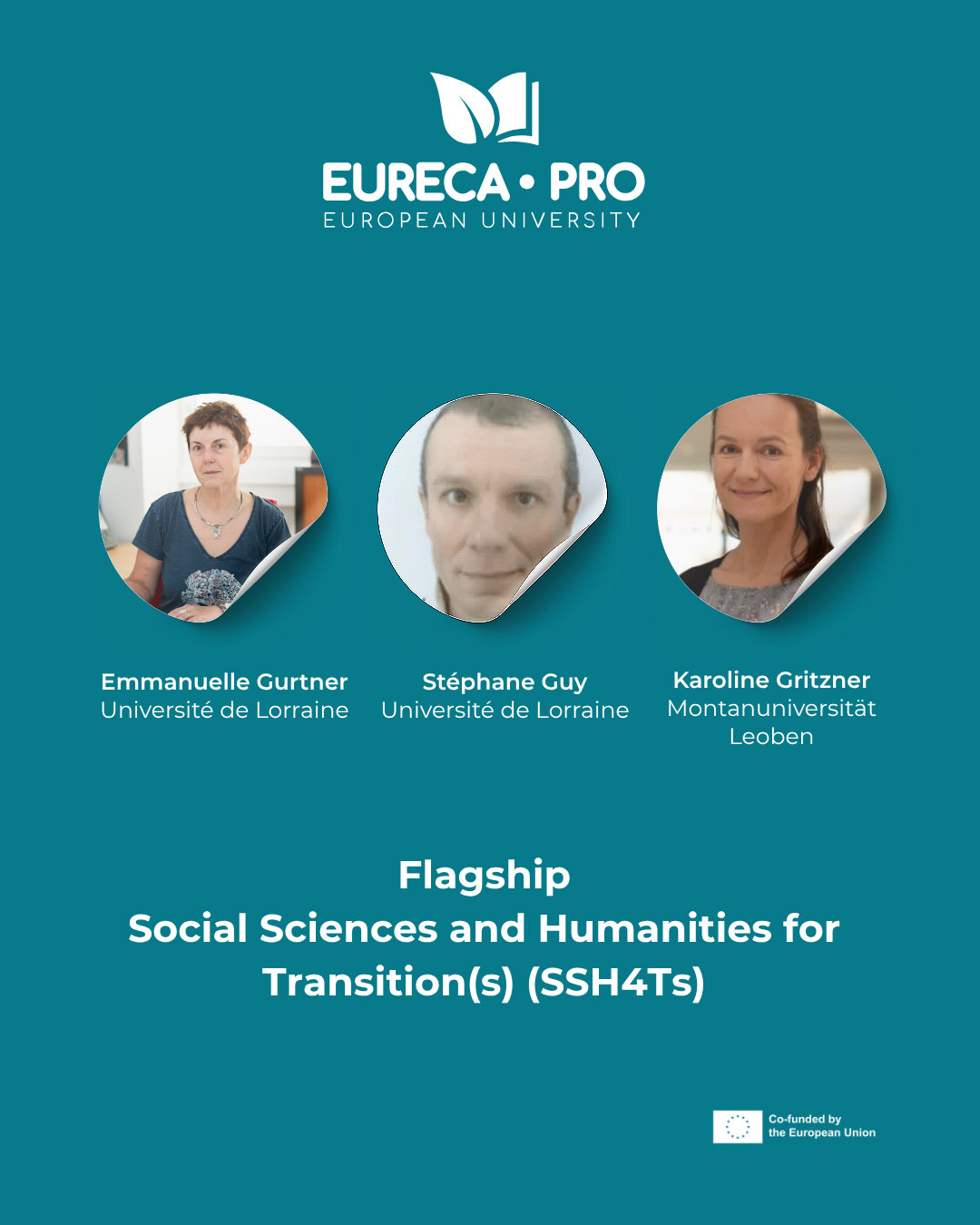
Emmanuelle Gurtner (Université de Lorraine) – emmanuelle.gurtner(at)univ-lorraine.fr
Stéphane Guy (Université de Lorraine) – stephane.guy(at)univ-lorraine.fr
Karoline Gritzner (Technical University of Leoben) – karoline.gritzner(at)unileoben.ac.at
