

Discovering EURECA-PRO's Flagships:
Energy in Transition
How can Europe accelerate the transition towards more sustainable energy production and consumption? The Energy in Transition Flagship brings together technical, social, legal, economic, design, and architectural expertise from across EURECA-PRO to address this major challenge. As the first in a series introducing the Alliance’s Flagships, this interview explores the ambitions of the Energy in Transition community and the collaborations it aims to develop in the years ahead.
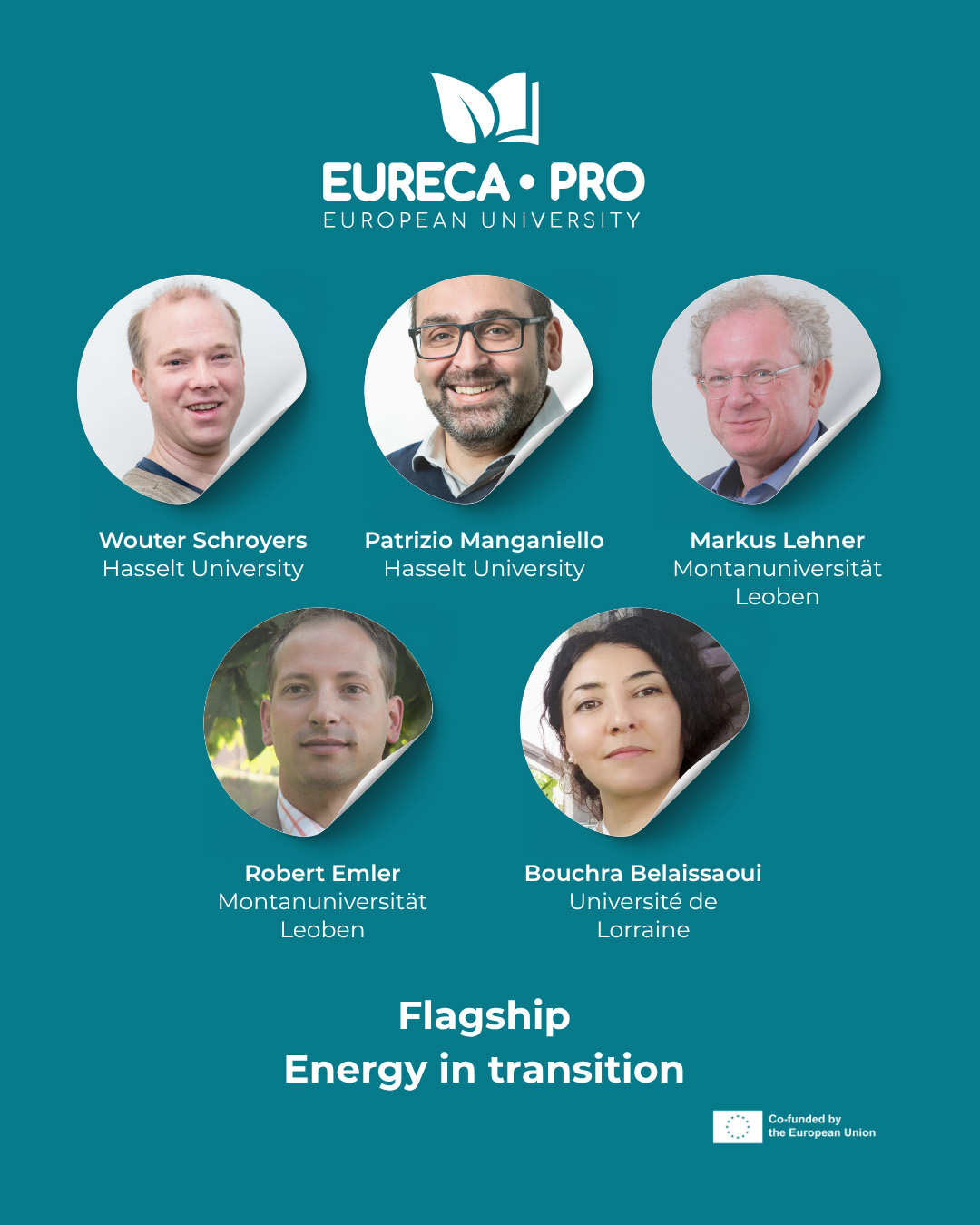
We talked to Wouter Schroeyers and Patrizio Manganiello from Hasselt University, Bouchra Belaissaoui from Université de Lorraine, and Robert Emler and Markus Lehner from the Technical University of Leoben about the challenges they are addressing, their vision for the flagship, and the opportunities they see for future collaboration. Their insights highlight how bringing together different disciplines and perspectives can help tackle the complex challenges of the energy transition.
What is the aim of your Flagship initiative, and what areas of expertise does it bring together within the EURECA-PRO Alliance?
The Energy in Transition Flagship operates as a transdisciplinary platform, bringing together expertise from the technical sciences, including photovoltaics, hydrogen, nuclear technology, batteries and carbon capture, as well as from the social sciences and humanities, with a focus on just transition and consumer behaviour.
Expertise in law and economics, particularly regulation and EU policy, as well as design and architecture, including inclusive energy systems, further contribute to this multidisciplinary approach.
The Flagship aims to integrate research and education in these areas across the different EURECA-PRO partners. Ultimately, it seeks to drive systemic innovation, pioneer integrated education and research models, and establish EURECA-PRO as a leading European alliance in the transition towards sustainable energy production, in line with EU priorities.
What research questions or societal challenges do you hope to help address through this European academic community?
Within EURECA-PRO, the Energy in Transition Flagship aims to advance Europe’s transition towards net-zero energy by integrating circularity, inclusiveness and resilience across the full energy lifecycle, from production and storage to consumption and end-of-life.
Positioned under EURECA-PRO’s Strategic Challenge C, Energy Transition and Sustainable Energy Management, the Flagship brings together technological innovation with the social, legal and economic dimensions of the energy transition.
In your view, what makes a EURECA-PRO Flagship initiative strong, and what do you hope to achieve collectively in the coming years?
By connecting the activities of existing local partners across research, education and the third mission through the EURECA-PRO Energy in Transition Flagship, we aim to build on established expertise and networks, ensure a broad and diverse range of activities, and ultimately foster synergies among partners from different backgrounds and disciplines across the Alliance.
The Flagship seeks to stimulate intensive interdisciplinary collaboration between EURECA-PRO’s researchers and educators at different levels. This includes making EURECA-PRO’s energy-related educational modules and training easier to find and navigate, supporting seed funding for microprojects led by professors and postdoctoral researchers, and allocating part of the budget to PhD-led networking and collaboration initiatives across the Alliance.
It will also support bachelor and master’s students through activities such as hackathons and training schools.
Contacts:
Wouter Schroeyers (Hasselt University): wouter.schroeyers(at)uhasselt.be
Bouchra Belaissaoui (Université de Lorraine): bouchra.belaissaoui(at)univ-lorraine.fr
Patrizio Manganiello (Hasselt University): patrizio.manganiello(at)uhasselt.be
Robert Emler (Technical University of Leoben): robert.emler(at)unileoben.ac.at
Markus Lehner (Technical University of Leoben): markus.lehner(at)unileoben.ac.at
