

Where Collaboration Begins:
Inside the First EURECA-PRO Staff Buddy Community
What happens when international relations professionals from across Europe come together to learn, exchange experiences and build lasting connections? The first edition of the EURECA-PRO Staff Buddy Community set out to answer that question through a five-month programme combining virtual collaboration and an intensive Staff Week in Chania, Greece.
Behind this initiative is Maryann Borraccino, Head of the International Relations Office, who envisioned the Staff Buddy Community as more than a mobility activity: a space for professional growth, peer learning and intercultural exchange. Following the conclusion of the first edition, she reflects on the programme’s achievements and its future within EURECA-PRO.
Where did the idea for the Staff Buddy Community come from, and what need were you hoping to address within EURECA-PRO?
The grant agreement calls for the creation of a staff buddy programme. When I started thinking about how to implement this task, I first considered the typical buddy system, where a staff member is paired with a peer during a mobility period at another university.
However, I realised that these types of interactions are often quite short-term and can easily fade once the mobility ends. So I thought it would be more meaningful to create something more sustainable: a community, or even several communities, where staff with similar roles across partner universities can come together to share best practices and help each other find solutions to common challenges.
In most cases, staff already communicate by email, but usually for very specific and task-oriented reasons. What was missing, in my view, was a space for exchange that combines professional topics with a more informal, peer-to-peer dimension. There was clearly a need for this within EURECA-PRO, and I believe with the Staff Buddy Community we are starting to address it.
It was also a great opportunity to collaborate closely with Afroditi Fotiou (TUC) on capacity building, as well as with Anna Rath (MUL). Dina Fragkedaki (TUC) also provided essential support for the on-site programme.

Where did the idea for the Staff Buddy Community come from, and what need were you hoping to address within EURECA-PRO?
The grant agreement calls for the creation of a staff buddy programme. When I started thinking about how to implement this task, I first considered the typical buddy system, where a staff member is paired with a peer during a mobility period at another university.
However, I realised that these types of interactions are often quite short-term and can easily fade once the mobility ends. So I thought it would be more meaningful to create something more sustainable: a community, or even several communities, where staff with similar roles across partner universities can come together to share best practices and help each other find solutions to common challenges.
In most cases, staff already communicate by email, but usually for very specific and task-oriented reasons. What was missing, in my view, was a space for exchange that combines professional topics with a more informal, peer-to-peer dimension. There was clearly a need for this within EURECA-PRO, and I believe with the Staff Buddy Community we are starting to address it.
It was also a great opportunity to collaborate closely with Afroditi Fotiou (TUC) on capacity building, as well as with Anna Rath (MUL). Dina Fragkedaki (TUC) also provided essential support for the on-site programme.
Looking back on this first edition, was there a particular moment when you thought, “This is exactly what we hoped to achieve”?
There were several moments when I felt, “this is exactly what we hoped to achieve.”
First, during the online part of our blended intensive programme (BIP), seeing participants return month after month and actively engage in the sessions was very encouraging. It showed that, despite their busy schedules, people were genuinely interested in being part of this community and were willing to make time for it.
During the in-person staff week, there were also several defining moments. One was a session where participants presented best and worst practices. They shared situations where they had faced challenges, and in some cases others were able to offer solutions, while in others they collectively tried to find answers. That dynamic is really at the heart of what this community is meant to be.
Another key moment was the session led by Professor Jérôme Diguet (UL), who presented a virtual exchange programme he had implemented at his university and explained how others could develop similar initiatives. The level of discussion and the questions it sparked made me think, “yes, this is exactly the point”: these exchanges can directly inspire ideas that will benefit both academics and students across the alliance.
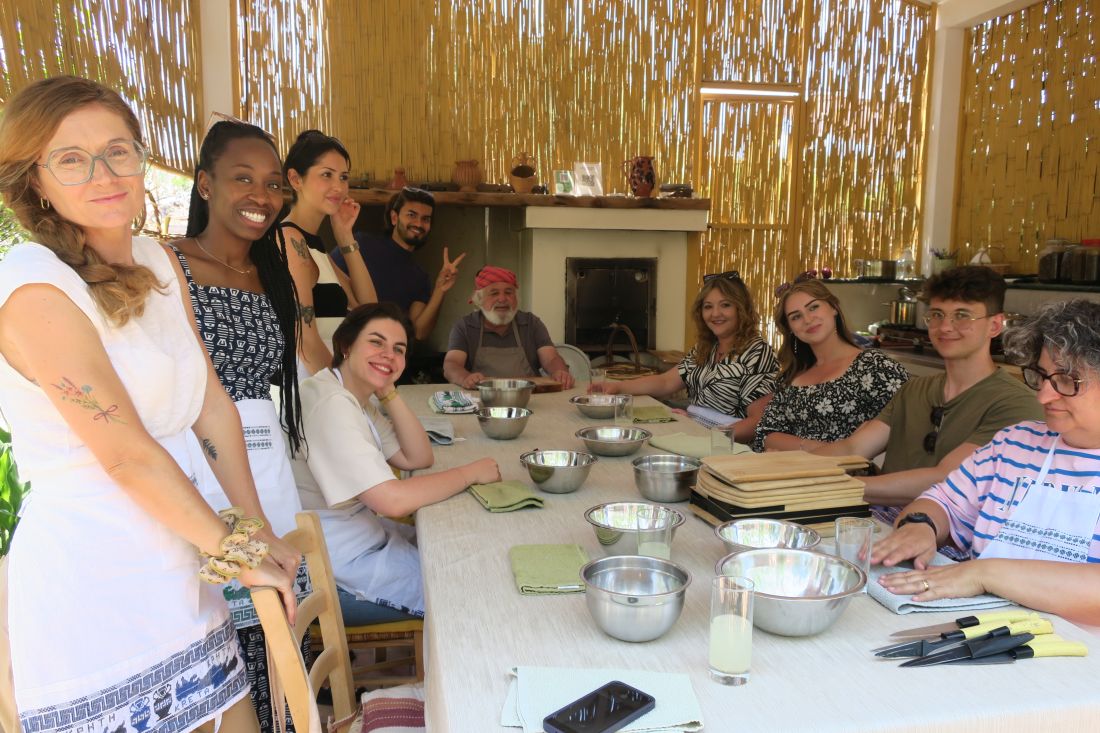
And on a more informal note, the Cretan cooking experience was also very meaningful. It was a cultural activity that really brought the group together. By that stage, participants were already connecting well, but rolling out pastry, cutting vegetables, and cooking together in the Cretan heat really strengthened those bonds.
Another key moment was the session led by Professor Jérôme Diguet (UL), who presented a virtual exchange programme he had implemented at his university and explained how others could develop similar initiatives. The level of discussion and the questions it sparked made me think, “yes, this is exactly the point”: these exchanges can directly inspire ideas that will benefit both academics and students across the alliance.
And on a more informal note, the Cretan cooking experience was also very meaningful. It was a cultural activity that really brought the group together. By that stage, participants were already connecting well, but rolling out pastry, cutting vegetables, and cooking together in the Cretan heat really strengthened those bonds.
The Staff Buddy Community was conceived as more than a one-off mobility activity. How do you envision this community evolving in the coming years, and what role can it play in strengthening cooperation across EURECA-PRO?
Yes, absolutely—we intend to continue and expand this initiative by creating additional communities. The next edition will hopefully include two communities running in parallel, and we are confident that this will further strengthen capacity building across the alliance.
We also hope to continue using the BIP format, as it has proven to be a very effective way to combine virtual exchange with in-person collaboration. There are still many relevant topics we can explore and many opportunities to bring people together within the EURECA-PRO network.
Overall, the aim is to further strengthen cooperation across the alliance, and I am very much looking forward to welcoming the next group of participants later this year.
