

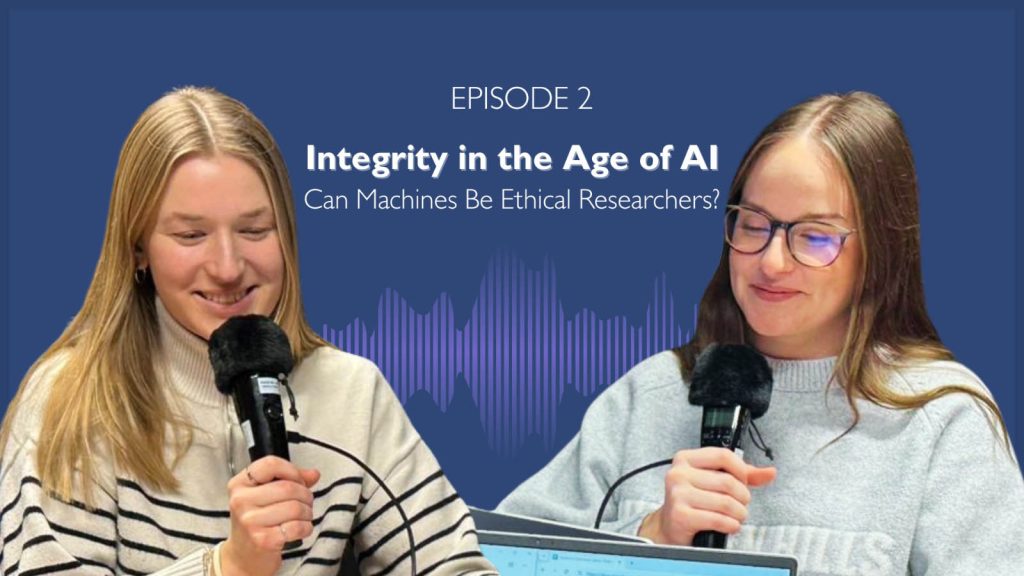
Science Ethics Ep. 2 -
Integrity in the Age of AI
Host: Mittweida University of Applied Sciences
- Scientific Conversations, Student Sessions
- English
As part of the special Podcast edition “Science Ethics”, the episode explores how artificial intelligence is transforming medical research and diagnostics and examines whether machines can act as ethical researchers. Through a conversation between the hosts and insights from an expert in medical imaging and AI, the episode addresses:
- AI in scientific discovery and ethical responsibility
- Pattern recognition in complex medical data
- Support for high-stakes diagnostic decisions
- Ethical concerns such as opacity, bias, and responsibility
- Challenges around errors and ownership of AI-generated results
The discussion combines host dialogue with expert perspectives to connect practical AI applications with broader ethical implications. While AI can strengthen and support research processes, it cannot assume moral accountability.
Ultimately, the episode highlights that trustworthy science continues to depend on transparency, explainability, and human oversight in the age of AI.
The podcast was produced by the students by Ida Fischer, Rosalie Haas, Lilly Wende, and Iryna Zavadska, who participated in the course Science Ethics and Research Integrity during winter semester 2025/2026. The episode is one out four of the special edition “Science Ethics”.
Enjoy listening:
Sources:
- Bundesministerium für Ernährung und Landwirtschaft (BMEL): Künstliche Intelligenz (KI) für eine nachhaltigere Landwirtschaft, 2021, [online] https://www.bmleh.de/SharedDocs/Downloads/DE/Broschueren/k-i-fuer-nachhaltige-landwirtschaft.pdf?__blob=publicationFile&v=6
- Bianchini, Stefano/Müller, Moritz/Pelletier, Pierre: Artificial intelligence in science: An emerging general method of invention, Vol. 51, Issue 10, 2022, [online] https://doi.org/10.1016/j.respol.2022.104604
- Dickens, Robert: UK decides AI cannot be named an inventor of a patent, A&O Shearman, 2023, [online] https://www.aoshearman.com/en/insights/ao-shearman-on-tech/uk-decides-ai-cannot-be-named-an-inventor-of-a-patent
- Hasani, Navid et al.: Artificial Intelligence in Medical Imaging and its Impact on the Rare Disease Community: Threats, Challenges and Opportunities, in: PET Clinics, Vol. 17, Issue 1, 2022, pp. 13-29, [online] https://doi.org/10.1016/j.cpet.2021.09.009
- Healthdirect Australia: PET scan, healthdirect, 2024, [online] https://www.healthdirect.gov.au/pet-scan
- Hirani, Rahim: Artificial Intelligence and Healthcare: A Journey through History, Present Innovations, and Future Possibilities, Vol. 14, Issue 5, 2019, [online] https://doi.org/10.3390/life14050557
- Jiang, Liwei et al.: Can Machines Learn Morality? The Delphi Experiment, Cornell University, 2022, [online] https://doi.org/10.48550/arXiv.2110.07574
- Lin, Dana J. et al.: Artificial Intelligence for MR Image Reconstruction: An Overview for Clinicians, in: Journal of Magnetic Resonance Imaging, Vol. 53, Issue 4, 2021, [online] https://doi.org/10.1002/jmri.27078
- Mundorf, Anna Katharina et al.: Künstliche Intelligenz im medizinischen Labor: KI – aktueller Stand und Zukunftsperspektiven. in: Trillium Diagnostik, Issue 1/2024, pp. 58-62, 2024, [online] https://doi.org/10.47184/td.2024.01.08
- Nilsson, Nils J.: THE QUEST FOR ARTIFICIAL INTELLIGENCE. A HISTORY OF IDEAS AND ACHIEVEMENTS, Stanford University, 2009, [online] https://ai.stanford.edu/~nilsson/QAI/qai.pdf
- Oratz, Lisa T./West, D. Sean.: Human Authorship Requirement Continues To Pose Difficulties for AI‑Generated Works, Perkins Coie LLP, 2024, [online] https://perkinscoie.com/insights/article/human-authorship-requirement-continues-pose-difficulties-ai-generated-works
- Resnik, David B./Hosseini, Mohammad: The ethics of using artificial intelligence in scientific research: new guidance needed for a new tool, in: AI and Ethics, Vol. 5, Switzerland: Springer, 2024, pp. 1499-1521, [online] https://doi.org/10.1007/s43681-024-00493-8
- Stryker, Cole/ Kavlakoglu, Eda: What is artificial intelligence (AI)?, 2024-2025, [online] https://www.ibm.com/think/topics/artificial-intelligence
- Virginia Tech Division of Scholarly Integrity and Research Compliance: Guidance: Using artificial intelligence during research activities (SIRC‑0031), Virginia Tech, 2024, [online] https://www.research.vt.edu/content/dam/research_vt_edu/sirc/files/sirc-guidance-for-ai.pdf
Committed to Planet A, the EURECA-PRO Podcast series features inspiring interviews, conversations and presentations involving leading professors, researchers, students and administrative staff of the European University on Responsible Consumption and Production – EURECA-PRO.
The main purpose of the EURECA-PRO Podcast Series is to bring to the foreground innovative research approaches, inspiring ideas and experiences from different members and associated participants of the EURECA-PRO community and share them with the extended academic communities of the alliance’s partner institutions. The wider scope is to inform students and staff about innovative thinking and research, student experiences, as well as best practices and opportunities on RCP with reference to EURECA-PRO’s ongoing programme of events and activities.
