

Transferable skills:
from academia to everyday life and beyond
A recap of the EURECA-PRO Transversal Skills Week
- News

During the week of 2 to 6 March 2026, doctoral researchers from across the EURECA-PRO alliance came together online for the first EURECA-PRO Transversal Skills Week, a five-day training programme dedicated to strengthening essential skills that complement academic expertise.
Organised by the EURECA-PRO Doctoral School, the week focused on a series of highly interactive workshops covering networking and collaboration, public speaking, creativity and problem solving, project management, and digital and AI literacy for research. Each session was led by experienced trainers and designed in a workshop format with limited participant numbers to encourage active participation and exchange.
The programme itself was shaped by doctoral researchers. Topics were selected through a survey of PhD students in the Doctoral School, ensuring that the sessions addressed real needs and everyday challenges in doctoral research and beyond.
Throughout the week, PhD students from universities across the EURECA-PRO consortium attended the sessions, creating a lively international learning environment and enabling participants to exchange experiences across disciplines, institutions and research cultures.
Building meaningful research networks
The week opened with a session on Networking for Researchers, led by Joeri Wielandts from KU Leuven. Rather than presenting networking as a purely strategic exercise, the workshop focused on building authentic professional relationships.
Participants explored how preparation can make networking more effective, how to develop a personal brand on LinkedIn, and how consistent online engagement can help researchers share their work and connect with others in their field. The session also included practical exercises and breakout discussions, allowing participants to practise networking techniques during the training itself.
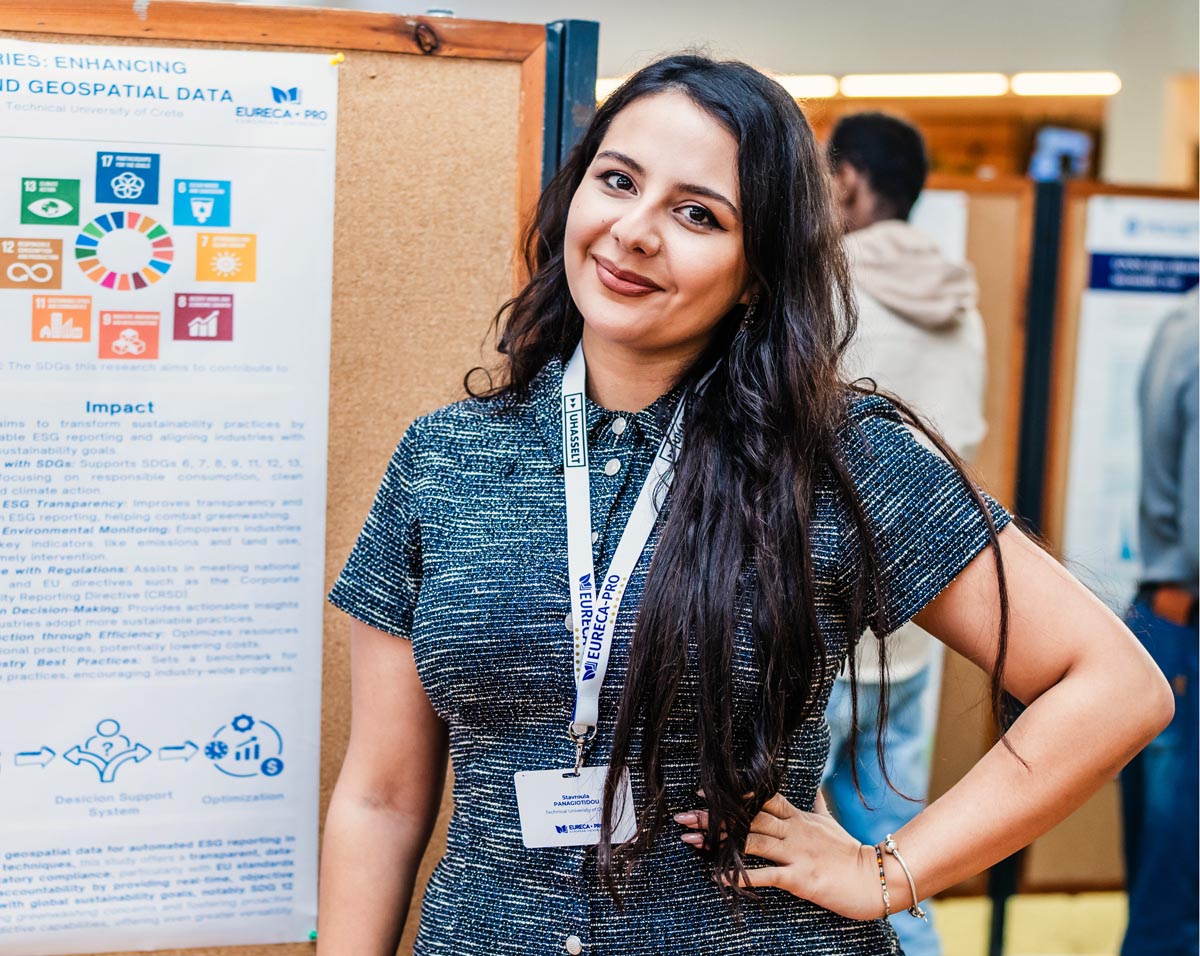
Stavroula Panagiotidou highlighted the supportive atmosphere created during the workshop:
“The whole environment, from the facilitator to the participants, felt really safe to express freely and be yourself, open to learn and apply.”
Stavroula Panagiotidou, Technical University of Crete
Another participant appreciated the session’s practical focus, particularly the insights on LinkedIn and professional interaction.
Communicating research with confidence
The second workshop focused on Public Speaking and Presentation, delivered by Dr Ana Patricia Fanjul Alemany and Dr Ángel Morán Muñoz from the University of León, both graduates of the EURECA-PRO Doctoral School.
The session explored three key aspects of effective presentations: non-verbal communication, verbal communication, and managing stage fright. Participants received practical guidance on body language, voice control and audience engagement. A central exercise asked several participants to present their research at the beginning of the session and reflect on how they would improve their presentation after the training. This hands-on approach allowed doctoral researchers to immediately apply the tips discussed during the workshop.
As Elysée Nzigire Rutakaza, one of the participants, noted:
“The training provided useful tips on how to prepare a clear presentation and effectively communicate our work. It also helped reduce the stress associated with public speaking by reminding us that many people face this challenge and that confidence improves with practice.”
Elysée Nzigire Rutakaza, Hasselt University
Unlocking creative thinking in research
Creative thinking and problem-solving were at the heart of the third session, facilitated by Dr. Jamie McDonald. The workshop encouraged participants to reflect on how creativity emerges in research and how researchers can deliberately create the mental conditions that allow new ideas to surface.
Participants explored the concept of the “quiet voice” of creativity and discussed how a balanced, relaxed and open state of mind can help generate new insights. Practical exercises encouraged researchers to recognise moments of creative thinking and capture ideas through active note-taking, gradually strengthening their creative habits.
The session also invited participants to identify factors that can limit creative thinking in research environments and to discuss strategies for overcoming these barriers.
Understanding the basics of project management
In the Crash Course in Project Management, Dr Eng. Seweryn Tchórzewski from the Silesian University of Technology introduced participants to the fundamentals of managing research projects.
Ahead of the session, participants completed a short survey about their experiences with project management, the types of projects they are involved in, and the challenges they encounter. This helped tailor the training to the participants’ needs and expectations.
The session provided an overview of key project management concepts and highlighted resources for researchers who want to further develop their project management skills.
Anna Kurianowicz reflected:
“The training covered the basics of project management, but thanks to it, I learned in which direction to develop further in Project Management. It is a broad topic, and without the course, I would not have known what to do next.”
Anna Kurianowicz, Silesian University of Technology
Exploring AI and machine learning in research
The final session of the week focused on Introduction to AI and Machine Learning, delivered by Prof. Dr Kris Luyten, Prof. Dr Gustavo Rovelo, and Prof. Dr Davy Vanacken from Hasselt University.
The workshop was structured in three parts. First, the trainers introduced the fundamentals of artificial intelligence and machine learning, including the risks and biases that can arise from training data. The second part focused on discussion, inviting participants to debate how AI tools can and should be used in doctoral research. In the final part, Yarne Dirkx, a PhD student at Hasselt University, provided a hands-on exploration of AI tools to support literature reviews and other research tasks.
Participants appreciated the opportunity to combine conceptual understanding with practical experimentation.
“The most important insight I gained was basic knowledge about how to apply machine learning in my PhD thesis.”
Lucia Galucci, Universidad de León
Looking ahead
The strong interest in the Transversal Skills Week suggests a clear demand for this type of training within the EURECA-PRO community. Each workshop attracted a large number of preregistrations, confirming that doctoral researchers are eager to develop skills that complement their academic expertise.
Following the success of this first edition, the organisers are already reflecting on future editions of the programme. Possible next steps include exploring new formats, expanding the range of topics, and potentially focusing more strongly on methodological skills in addition to transversal competencies.
